
My King James Bible has a pencil note in the margin of Jeremiah 33. It says “333?” and nothing else, written after a week of glances at the oven clock.
I wanted a verse for those digits.
My concordance gave me an empty column.
That empty column is where this study starts.
Scripture never writes the number 333, so whatever it means for a Bible reader has to be assembled from parts: the Hebrew habit of repetition for weight, the third day of Genesis and Hosea, one cry of seraphim in a temple, and a handful of readers through history who added up letters like coins on a table.
One date outside the Bible matters here as well. It is a battle.
Isaiah 6:3, Jeremiah 33:3 and the first third day
Order matters in a study like this, so I check the first appearance before anything else.
The idea enters Scripture as an ordinal, inside the creation week: “And the evening and the morning were the third day” (Genesis 1:13, KJV). The cardinal number waits until the genealogy of Genesis 5.
The text that made the pattern famous belongs to the temple vision Isaiah dates to the year King Uzziah died:
“And one cried unto another, and said, Holy, holy, holy, is the LORD of hosts: the whole earth is full of his glory.” (Isaiah 6:3, KJV)
John hears the same cry in heaven, centuries later, from four creatures with six wings apiece: “Holy, holy, holy, Lord God Almighty, which was, and is, and is to come.” (Revelation 4:8, KJV)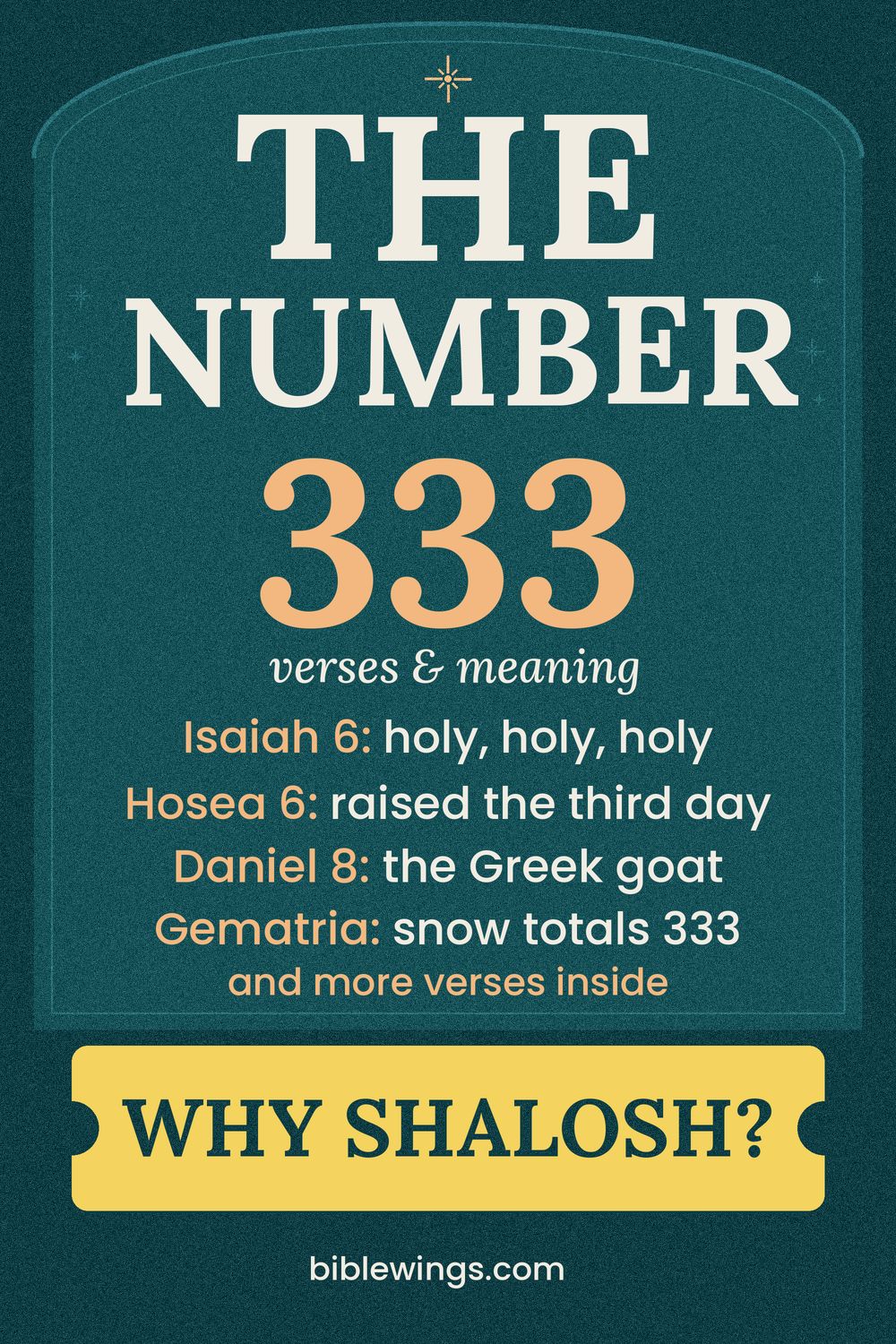
Jeremiah 33:3 is the verse search engines push hardest for this number: “Call unto me, and I will answer thee, and shew thee great and mighty things, which thou knowest not.” (Jeremiah 33:3, KJV, BibleGateway)
The promise has it’s context in a siege. Jeremiah 33:1 places the oracle “while he was yet shut up in the court of the prison”, and chapter 32 explains that the army of Babylon surrounded Jerusalem at the time.
A prophet under guard was the original hearer. For years the promise explained me nothing, because I treated it as a slogan on a mug, and only when I read chapter 32 straight into chapter 33 did the call to prayer sound like what it was, a message given to a man who was not free to leave a courtyard while the city around him starved.
One more, because the prophets revisit the theme:
“After two days will he revive us: in the third day he will raise us up, and we shall live in his sight.” (Hosea 6:2, KJV, BibleGateway)
Shalosh
The Hebrew term is shalosh (Strong’s H7969), an ordinary cardinal number. Blue Letter Bible counts it as “three” 388 times in the KJV, with extra entries for thirteen and thrice (Blue Letter Bible, H7969). Daily life is full of it. Laban sets “three days’ journey” between his flocks and Jacob in Genesis 30:36 (KJV), and the hangings at the tabernacle gate in Exodus 38:14 rest on pillars counted out by shalosh.
Greek uses treis (Strong’s G5140), which the KJV translates “three” 69 times. Its adverb tris (G5151) means “thrice” and appears twelve times in the New Testament. Peter’s denial uses it: “Verily I say unto thee, That this night, before the cock crow, thou shalt deny me thrice.” (Matthew 26:34, KJV)
None of these terms hides a code. Repetition supplies the weight. A prophet who wants force repeats the noun, and once more:
“O earth, earth, earth, hear the word of the LORD.” (Jeremiah 22:29, KJV)
Issus, 333 BC
Here is the battle. In 333 BC (a year written with exactly these digits, which still makes me smile) Alexander of Macedon defeated the Persian king Darius III at Issus, in what is now southern Turkey, a victory Britannica names as decisive in his conquest of the Achaemenid Empire (Britannica). Livius dates the fight to 5 or 6 November.
Why would a Bible student care? Daniel 8 has a goat.
“And the rough goat is the king of Grecia: and the great horn that is between his eyes is the first king.” (Daniel 8:21, KJV)
Older commentaries on Bible Hub name that horn as Alexander the Great. Josephus (37-c. 100) went further. In Antiquities 11.317-345 he tells how Alexander came to Jerusalem, where the high priest showed him the book of Daniel, and the king accepted the prophecy of a Greek who would destroy the Persian empire as a prophecy about himself.
Scholars split here. Livius notes that most historians reject the visit, partly because critical scholarship dates Daniel to the second century BC, while traditional Jewish and Christian readers place the book in the sixth century BC and accept Josephus at his word.
My view on that dispute has moved more than once over the years, and the part that stays with me is smaller and stranger than the debate: the most famous 333 of the ancient world, the year a Macedonian army broke a Persian king by the sea, belongs in Bible study to the goat of Daniel’s vision and to no microwave.
Seraphim in the synagogue and the liturgy
Jewish worship voices Isaiah 6:3 daily. In the Kedushah, recited in the leader’s repetition of the Amidah, the congregation and the leader say “Holy, holy, holy is the Lord of hosts, the whole world is full of His glory,” and answer with Ezekiel 3:12, “Blessed is the Glory of God from His place”.
Rashi (1040-1105) keeps his note short: “Three times, as the Targum renders”.
The targum (an Aramaic translation and paraphrase of the Hebrew Bible) spells the three out: holy in the highest heavens, holy upon the earth, holy for ever.
Ibn Ezra hears in the repetition the continuity of the praise, and he compares Jeremiah 7:4 and 22:29 (Sefaria, Ibn Ezra).
Orthodox Christians sing a different hymn, the Trisagion: “Holy God, Holy Mighty, Holy Immortal, have mercy on us.” Greek tradition places its origin under Patriarch Proclus of Constantinople (434-446), with a story of an earthquake and a boy lifted into the air who heard angels sing it, and the bishops at the Council of Chalcedon in 451 chanted it as an acclamation.
In the Byzantine Divine Liturgy it precedes the Epistle, and John of Damascus understood it as addressed to the Trinity.
Catholics meet the seraphim at the Sanctus. At Mass the Preface closes with the threefold acclamation of Isaiah, followed by the “Hosanna” and “Blessed is he who comes” of the Palm Sunday crowd, so the vision of Isaiah 6 is sung on Sunday mornings in parish churches on several continents.
Of all the places the number three lives in church worship, this place in the liturgy is the likeliest to be familiar to Western churchgoers.
On the Protestant side, the Anglican scholar E. W. Bullinger (1837-1913) made a system of it. His Number in Scripture calls three the number of divine perfection and assigns the cry “one for each of the three persons in the Trinity”.
His catalogue runs from one up to six hundred sixty-six. Nothing in it covers three hundred thirty-three.
I am split on this one. The Trinitarian view is old and lovely, and the grammar still works without it, as the Ibn Ezra note a few paragraphs up shows. It depends of the reader which of the two wins out.
Context changes the number
Said thrice in the prophets
In Isaiah and Jeremiah the repeated noun is volume. Jeremiah 7:4 mocks a crowd that repeats “The temple of the LORD” as a charm, and Jeremiah 22:29 calls the land to listen. Urgency, no arithmetic.
Gospels and the third day
Jesus ties his burial to Jonah’s three days and three nights in Matthew 12:40. Peter denies him (Matthew 26:34), and the risen Jesus asks Peter a question by the lake again and again in John 21:15-17, which I take as repair more than rebuke.
Paul prays thrice about the thorn in 2 Corinthians 12:8, and his creed in 1 Corinthians 15:4 dates the resurrection to the third day. Did any Gospel writer think of a trio of threes? No text says so.
On a clock or in a dream
Most of people who search this number saw it on a phone or a receipt, and some saw it in a dream. Scripture’s closest parallel is Joseph in prison, who hears the cupbearer’s dream and says “the three branches are three days” (Genesis 40:12, KJV), and gives the baker’s three baskets the same span in Genesis 40:18. Joseph is careful to credit God with the interpretation (Genesis 40:8). Church traditions treat these as Joseph’s gift in Egypt, and none of them teaches that a modern clock brings a message of that sort.
As a gematria value
Gematria adds up the number values of Hebrew letters. The noun for snow is sheleg (Strong’s H7950), spelled shin (300), lamed (30) and gimel (3), which totals 333 (Bible Hub, H7950). Isaiah 1:18 uses that very noun: “though your sins be as scarlet, they shall be as white as snow” (KJV). The Bible teacher Chaim Bentorah adds that shikhechah, “forgetfulness,” totals 333 as well (shin 300, kaf 20, chet 8, he 5), and he reads snow as a picture of God’s cover over sin. That is a teacher’s interpretation. Isaiah himself says nothing about letter values, and the text stops at snow and wool.
Thrice, at a glance
I keep a smaller version of this grid on an index card in the back of my Bible. Ten rows, in no special order:
| Where it appears | What it stands for there | Verse |
|---|---|---|
| Seraphim before the throne | “Holy” said thrice | Isaiah 6:3 |
| Creation week | dry land and seed | Genesis 1:13 |
| Jonah in the fish | the sign of burial | Matthew 12:40 |
| A prophet under guard | who answers a call? | Jeremiah 33:3 |
| Four creatures in heaven | praise with no rest | Revelation 4:8 |
| Hebrew noun for snow | letters total 333 | Isaiah 1:18 |
| The cupbearer’s dream | branches mean days | Genesis 40:12 |
| Courtyard of the high priest | a denial, repeated | Matthew 26:34 |
| The land of Judah | “earth” as alarm | Jeremiah 22:29 |
| Hosea’s lament | raised on day three | Hosea 6:2 |
The angel number claim
Two most common claims online deserve a fair look. The angel claim calls 333 an “angel number,” a signal that heavenly helpers are near. That idea started with the New Age author Doreen Virtue, and her Angel Numbers 101 presented 333 as a sign of “ascended masters” nearby. In 2017 Virtue was baptized and renounced her New Age teaching for Christianity. In 2022 she told the story in Christianity Today (Christianity Today). The author of the system left it, and Scripture gives no text for it either way.
The second claim calls Jeremiah 33:3 “God’s phone number.” The promise is real, and the digits are an accident of print. Stephen Langton devised the modern chapter divisions in the early thirteenth century, and the Paris printer Robert Estienne numbered verses in his Greek New Testament of 1551.
Jeremiah wrote with no numbers at all, and the Josephus story two sections up makes the same point about Daniel: the scrolls are ancient and the apparatus is late.
How I study this
My method for any number is slow and a bit stubborn.
I open Blue Letter Bible, search H7969, and sort the results by book, so I can see where shalosh clusters (the Torah’s measurements, the oracles of the prophets, Daniel’s weeks, the days of the Gospels) before I trust any theory about it. Next I read Isaiah 6 aloud in the KJV and in the World English Bible, since two English voices slow me down enough to notice the smoke and the coal.
After that comes Sefaria, with Rashi and Ibn Ezra open side by side, and a pencil for the margin, where I write Revelation 4:8 next to Isaiah 6:3 and Jeremiah 22:29 next to Jeremiah 7:4, a habit I owe to an old reference Bible with cross-columns in the centre of each page, my earliest commentary, in effect, long ahead of any proper set of volumes.
The clock thing is no big deal to me now. When I close the study I pray Jeremiah 33:3 in the old King James English, a clause at a time, and stop.
When the number unsettles someone
Some readers see 333 again and again and feel afraid, or feel pressed to decode it before something bad happens.
The biblical pattern of three speaks of God’s holiness and of the hope of resurrection, and nothing in it treats a clock as an omen.
If the number brings real fear or sleepless nights, a pastor or priest is a good person to talk with, so is a counsellor, and a doctor is the right call if the worry will not lift.
READ THIS NEXT: Biblical meaning of the number 333